Where Faith Meets the Fossil Record

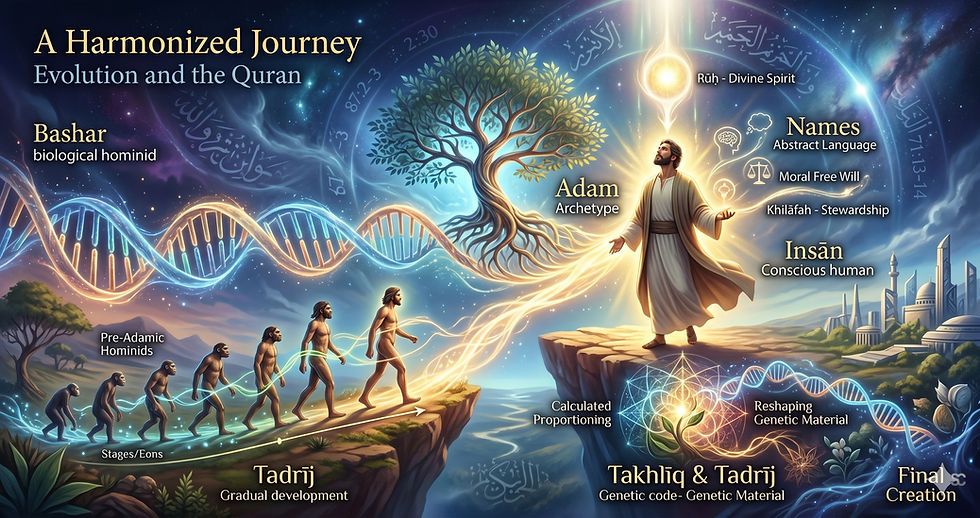
4 Mind-Bending Insights on Evolution in the Quran
1. Introduction: Moving Beyond the "God vs. Darwin" Binary
The perceived conflict between religious tradition and evolutionary science often stems from a defensive, flat literalism that fails to grasp the majesty of the "Two Books." There is the Written Book of scripture and the Open Book of Creation—the physical universe—and they cannot, by definition, contradict one another. To ignore the 3.8-billion-year history written in the earth’s strata to protect a narrow interpretation is a theological error: a kufr (covering up) of reality itself.
In scientific discourse, a "Theory" is not a mere hunch but the absolute gold standard of knowledge, a framework backed by genetics and the fossil record. True faith does not fear this empirical rigour, as the Quran describes its own verses as āyāt—signs or symbols that point toward deeper metaphysical truths rather than serving as a static history textbook. By approaching these signs with intellectual humility, we find that evolution is not a threat to the Divine but a revelation of His method.
2. Insight #1: We Were "Animal" Before We Were "Human" (Bashar vs. Insān)
A sophisticated reading of the Quranic text reveals a critical linguistic distinction between Bashar (the biological, physical hominid) and Insān (the conscious, spiritually awakened human). The Quran suggests that the physical vessel of humanity existed long before the divine selection of Adam, who serves as the archetype for a new state of being. This development reflects the morphological development of the Homo lineage, moving from earlier hominids like Homo habilis and Homo erectus into the refined physical form we recognise today.
This transition occurs in two distinct phases: Phase A, the biological shaping of the Bashar from the materials of the earth, and Phase B, the "Spiritual Leap." The physical vessel was the result of millions of years of natural history before it was ready for its metaphysical endowment.
"When your Lord said to the angels, 'Indeed, I am going to create a human (Bashar) from clay. So when I have proportioned him and breathed into him of My spirit (rūḥ), then fall down to him in prostration.'" — Surah Sad (38:71-72)
The introduction of the Rūḥ (Divine Spirit) is the moment of transcendence where the organism transitions from the animal state to the state of Insān. This allows us to embrace our biological lineage with the hominid tree while maintaining the unique spiritual status of modern humanity.
3. Insight #2: The Angels Weren't Predicting the Future—They Were Watching the Past
In the dialogue concerning the appointment of a "successive authority" (Khalīfah), the angels question why such a being would be placed on Earth. Their inquiry reveals not a prophetic foresight, but a retrospective observation of the biological theatre that preceded Adam.
"And, when your Lord said to the angels, 'Indeed, I will make upon the earth a successive authority (Khalīfah).' They said, 'Will You place upon it one who causes corruption therein and sheds blood...?'" — Surah Al-Baqarah (2:30)
The angels were likely observing the pre-Adamic Bashar, biological creatures driven by the primal instincts of survival and territoriality. These earlier members of the Homo genus operated on instinct, which naturally resulted in the shedding of blood and the "corruption" of competition.
The "creation of Adam" marks the endowment of advanced cognitive faculties, described functionally as the "teaching of the names." This represents the gift of symbolic language, conceptual categorisation, and moral accountability. Adam thus evolves from a "magical first man" into the crowning achievement of a long biological process, transitioning from instinct-driven reaction to the exercise of free will.
4. Insight #3: "Creation" is a Process of Measurement, Not a Magic Trick
In common discourse, "creation" is often misunderstood as an instantaneous disruption of natural laws. However, the Arabic root kh-l-q (Takhlīq) signifies the "proportioning" or "shaping" of pre-existing material into a new form. In the context of the fossil record, this pre-existing material is the genetic code itself, which is shaped and measured over time.
The Quran describes this as a "divine algorithm"—a calculated sequence of four distinct steps:
Shaping (khalaqa): The initiation of a biological form.
Proportioning (fa-sawwā): The balancing and smoothing of physical structures.
Destining/Programming (qaddara): The setting of genetic laws and limitations.
Guiding (fa-hadā): The continuous direction of the species to adapt and survive.
"Who created (khalaqa), then proportioned (fa-sawwā); And Who destined (qaddara), then guided (fa-hadā)." — Surah Al-A'la (87:2-3)
By using the present-continuous verb yakhluqu ("He creates"), the text emphasises that Takhlīq is an ongoing, adaptive process. Creation is not a finished historical event, but a constant implementation of natural laws to shape life-forms as they transition between states.
5. Insight #4: The Law of Stages (Tadrīj) and the 3.8 Billion Year Timeline
The principle of Tadrīj describes the gradual, incremental unfolding of life across vast eons. The Quran explicitly addresses the human journey as a multi-stage chronological progression rather than a single-moment event, using the word atwārā to denote distinct evolutionary intervals.
"What is the matter with you that you do not attribute to Allah majesty, while He has created you in stages (atwārā)?" — Surah Nuh (71:13-14)
Even the cosmic command "Be, and it is" (Kun faya kūn) supports this deep-time reality through its specific grammar. While the command is instant, the particle fa denotes immediate sequence, while the verb yakūn (it is becoming) remains in the present-continuous tense. The command is the spark; the manifestation is an unfolding process that may take billions of years.
The Quran also acknowledges the "unimaginable stretches of biological time" where humanity was not yet a self-aware entity. This alignment with the scientific observation of natural selection validates the generational sifting that occurred long before our arrival.
"Has there not come upon man a period of time from the eon (dahr) when he was a thing not [even] mentioned?" — Surah Al-Insan (76:1)
6. Conclusion: A Call to Intellectual Honesty
Evolution is not a departure from the divine order; it is the Sunnatullah—the method of God visible in the Open Book of Creation. To embrace this is to acknowledge that our physical forms were crafted through a patient, majestic process of deep time.
As Insān, we have been gifted with the responsibility of Khilāfah (stewardship), a role that bridges our biological past with our spiritual potential. We are the products of the earth who have been entrusted with a divine spark.
If the fossil record is a primary source of truth, then the study of evolution becomes a form of worship. How does your view of the Creator change when you see the 3.8-billion-year history of life not as a challenge to faith, but as His signature?


Comments