The Inheritance Revolution

5 Surprising Truths the Quran Reveals About Your Last Will
1. Introduction: The Math vs. The Mission
For many, the topic of Islamic inheritance evokes images of intimidating spreadsheets and specialist scholars. This traditional system, known as fara’id, is often presented as a rigid mathematical puzzle where every relative is assigned a fixed fractional share. The sheer complexity can make the process feel like a mechanical calculation rather than a personal act of care, leaving many Muslims feeling they have no agency over their own legacy.
However, as an information architect peeling back the layers of tradition, we find a "curiosity" hidden in the Quranic text: the intricate math that dominates the conversation is actually a secondary safety net. When read on its own terms, the Quran presents a straightforward and empowering system that prioritises personal responsibility and familial justice. By looking at the scripture directly, we find a flexible approach to estate planning designed to meet the real-world needs of every family.
2. The Priority Flip: The Will Comes First
In traditional inheritance law, fixed mathematical fractions are calculated first, and a personal will is treated as a restricted afterthought—often limited to a maximum of one-third of the estate. The Quranic text, however, establishes a completely different hierarchy.
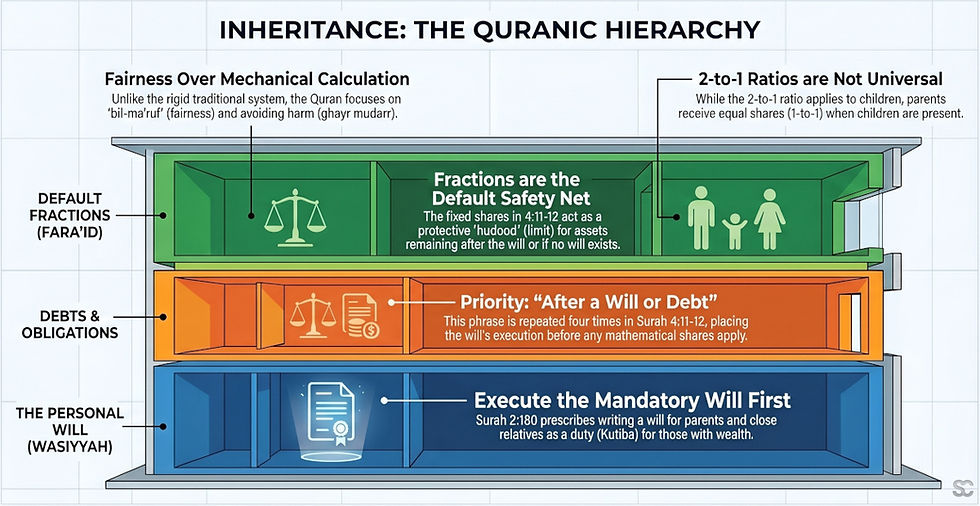
In Surah 4:11-12, the phrase min ba’di wasiyyatin ("after a will") acts as an absolute legal condition.
As a journalist tracking textual patterns, it is impossible to ignore the emphasis: this phrase is repeated four times in this short passage. It appears twice in verse 4:11 (once after child/parent allocations and again at the end of the verse) and twice in verse 4:12 (after spouse allocations and sibling allocations).
This repetition serves as a structural foundation. The Quranic hierarchy places the personal will (wasiyyah) as the primary action of the deceased. The fractional shares act as a "default safety net" for whatever remains, ensuring the family is protected only after your specific instructions are carried out.
"...after any will he recommends by it or a debt." (4:11-12)
3. Myth-Busting: Yes, You MUST Write a Will for Your Heirs
A common misconception is the "no will for an heir" rule, a traditional maxim claiming that a person cannot use a will to benefit those who already receive a fixed share. Many believe the inheritance verses "cancelled" the need for a personal will entirely.
The Quranic text explicitly contradicts this. In Surah 2:180, writing a will is described as kutiba (prescribed)—the same mandatory language used for fasting. Crucially, the Quran refers to the material inheritance not as a burden, but as khayr (goodness/wealth). The verse commands that this "goodness" be distributed via a will specifically for parents and close relatives.
"It is prescribed for you, when death approaches one of you—if he leaves wealth (khayran)—the wasiyyah for the parents and the close relatives, in fairness. A duty upon the conscious ones." (2:180)
This mandate allows you to address specific family needs that a rigid formula cannot account for—whether it is providing for an incapacitated child, a dependent spouse, or a relative who requires unique support. The will is a tool for distributing "goodness" with targeted justice.
4. The Gender Ratio is Not a Universal Rule
One of the most discussed aspects of Islamic inheritance is the "2-to-1" male-to-female ratio for children. While this is specified in Surah 4:11, the Quran proves that this is not a universal statement on the "worth" of gender.
For example, when a deceased person leaves behind children, the Quran instructs that the mother and father receive equal shares (1/6 each). This 1-to-1 ratio for parents demonstrates that gender does not automatically dictate a smaller share.
The 2-to-1 ratio for children and spouses is contextual, tied to the socio-economic framework of qawwamun (4:34)—the responsibility of men to provide for and maintain the household. In this system, the larger share is a reflection of a financial obligation to provide, not a higher rank of being. Where those obligations do not differ—as with parents—the Quran defaults to equality.
5. Goodbye to "Mathematical Impossibility"
Traditional systems occasionally encounter a problem called 'awl, where fixed shares add up to more than 100% of the estate (for example, totaling 112.5%). To fix this, scholars historically invented rules to proportionally reduce everyone’s share.
However, this mathematical clash only exists if you treat the fractions as the starting point. The Quranic solution is built into the sequence: the will serves as the "regulator" for the entire equation.
Because the fractions (1/8, 2/3, etc.) apply only to the net remainder after the will and debts are settled, the math works perfectly every time. If your will distributes 20% of your assets, the Quranic fractions apply to the remaining 80%. This ensures the total distribution always equals 100%, removing the need for invented scholarly interventions like 'awl.
6. Agency Within Boundaries: The Concept of "Fairness"
The Quranic inheritance system is one of "Dynamic Justice," trusting your conscience to distribute wealth while staying within divine parameters or hudood.
Traditional law often views these as "mechanical lines" or bullseyes you must hit perfectly. In the Quranic context, however, hudood are "safety boundaries." They are the fences you must stay within to ensure your distribution is Bil-ma'roof (recognised fairness) and Ghayr Mudarr (without causing harm). Within these boundaries, you have the agency to ensure actual fairness for your loved ones based on their unique realities.
Feature | Traditional Fara'id System | The Quranic Way |
Primary Priority | Fixed shares calculated first. | Will and debts take absolute priority. |
Will Capacity | Strictly limited (typically 1/3 max). | No percentage cap placed on the will. |
Beneficiaries | Will cannot benefit legal heirs. | Will is commanded for parents and kin (2:180). |
Gender Ratios | Rigid 2-to-1 ratio for almost all. | 2-to-1 for children/spouses; 1-to-1 for parents. |
Residuary Heirs | 'Asaba (male priority) takes what remains. | Not mentioned; will covers the distribution. |
Exclusion Rules | Certain relatives block others entirely. | No exclusion rules; shares based on presence. |
Logic Type | Mechanical, specialist-led calculation. | Dynamic justice based on personal agency. |
7. Conclusion: A System of Trust
The shift from a mechanical calculation to a Quranic model is a move from specialist-led complexity to personal responsibility. The Quran describes its own instructions as bayyin (clear) and designed to prevent you from "going astray."
By placing the will at the forefront, the Quran empowers you to act with taqwa (consciousness) and care for your family based on their specific needs. The fixed shares remain as a divine safety net, but the primary duty of justice lies with you.
If the Quran gives you the agency to ensure fairness for those you love most, are you prepared to take up that responsibility?
Research:


Comments