The Architect of Understanding: Deconstructing the Monopoly on Quranic Interpretation
- Qur'an Explorer

- Dec 20, 2025
- 9 min read
Updated: Dec 22, 2025
“Prophet Muhammad had the best understanding of the Qur’an!”
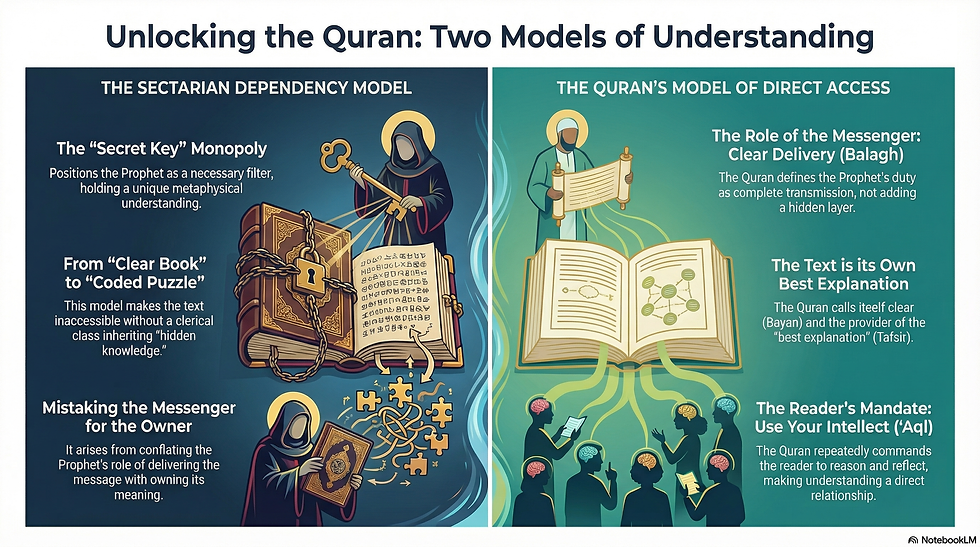
How many times have you heard this claim? For centuries, a dominant sectarian narrative has maintained that the Prophet Muhammad possessed a unique, metaphysical understanding of the Quran—a "secret key" that rendered his personal explanations the only valid lens through which the text can be understood. This belief creates a dependency model, positioning the Messenger as a necessary filter between the Creator and the created.
However, when we set aside man-made histories and narrations (hadith) and engage with the Arabic text of the Quran holistically, we find a discourse that systematically dismantles the idea of an interpretive monopoly.
1. The Genesis of the Sectarian Dependency
The belief that the Prophet "understood it better than anyone" often originates from a misunderstanding of the role of a Messenger (Rasul). Sectarianism conflates delivery with ownership. By claiming the text is "locked" without the Prophet’s external commentary, religious structures were able to establish a clerical hierarchy. If the text is not self-explanatory, the masses must rely on those who claim to inherit the Prophet’s "hidden" knowledge.
This model transforms the Quran from a "Clear Manifestation" into a "Coded Puzzle," effectively silencing the individual’s intellect.
1.1. The Origin of the Belief
From a structural perspective, the belief that the Prophet held an exclusive, superior "understanding" of the message often stems from a conflation of delivery and monopoly.
In many sectarian frameworks, the assumption is that because the rasul was the vessel for the revelation, he must have possessed a metaphysical "key" to its meanings that others lacked. This created a dependency model where the text is seen as locked, and the Prophet's behavior or extra-scriptural words act as the only valid cipher.
1.2. The Quranic Perspective on the Messenger's Role
When we look at the Arabic text of the Quran holistically, it defines the Messenger’s relationship to the message through specific functions.
The Duty is Proclamation (Balagh)
The Quran repeatedly defines the rasul's primary function as Al-Balagh (the clear delivery).
مَّا عَلَى الرَّسُولِ إِلَّا الْبَلَاغُ
(Ma 'ala al-rasuli illa al-balagh)
The text posits that the Messenger's success is measured by the completeness of the transmission, not by adding a secondary layer of "hidden" meaning. If the Messenger's "understanding" were a required supplement to the text, the balagh (proclamation) would, by definition, be incomplete without it.
The Teacher as a Guide, Not a Filter
The Quran mentions the Messenger's role in "teaching" (yu'allimuhum):
وَيُعَلِّمُهُمُ الْكِتَابَ وَالْحِكْمَةَ
(wa yu'allimuhumu al-kitaba wa al-hikmah)
In a hermeneutic sense, "teaching the book and the wisdom" implies demonstrating the application of its principles (hikmah), not overriding the text’s own clarity. The Quran describes itself as Mubayyan (made clear) and Nur (light). Light does not require an external flashlight to be seen; it reveals itself and its surroundings simultaneously.
The Prophet as the First Subject of the Text
Crucially, the Quran presents the Messenger as the first person bound by the text, rather than the master over it.
قُلْ إِنَّمَا أَتَّبِعُ مَا يُوحَىٰ إِلَيَّ مِن رَّبِّي
(Qul innama attabi'u ma yuha ilayya min rabbi)
"Say: I only follow what is revealed to me from my Sustainer."
This indicates that the Prophet’s understanding was a result of his submission to the text, making him the primary example of a student of the Quran, rather than a separate source of authority.
1.3. Hermeneutic Conclusions
If we treat the Quran as a self-correcting and self-explaining system (Tasreef), several points emerge:
Equal Access to Guidance: The Quran identifies itself as "Guidance for Humanity" (Hudan li al-nas). If the "true" understanding was locked within the Prophet's mind, the book would cease to be a universal guidance for those who live after him.
The Burden of Understanding: The text frequently uses the imperative Afala Tatafakkurun (Will you not then reflect?) and Afala Ya'qilun (Will you not then use your intellect?). These commands are directed at the listener/reader. They imply that the capacity to grasp the guidance is inherent in the human intellect ('Aql) when interacting with the text.
No Intermediaries in Meaning: The Quran warns against the "Rabbinic" model where people take their learned men as authorities beside the message. By asserting the Quran is its own best interpretation (Ahsana Tafsira), the text discourages the idea that any human—even the Messenger—acts as a barrier or a mandatory filter between the individual and the Creator's guidance.
In summary, while the Prophet is honored as the archetype of one who lived the message perfectly, the Quranic text suggests that the truth of the message is self-evident within the text itself. The Prophet understood it because he followed it; we are invited to do the same.
2. The Quranic Mandate: Proclamation, Not Filtration
The Quran defines the Messenger’s duty using the term Al-Balagh—the clear delivery.
مَّا عَلَى الرَّسُولِ إِلَّا الْبَلَاغُ
(Ma ‘ala al-rasuli illa al-balagh)
"There is nothing upon the Messenger except the delivery." (5:99)
If the Message required a secondary layer of "prophetic explanation" to be functional, then the "delivery" would be incomplete. The Quranic argument is that the text is Mubayyan (Manifested/Self-Evident). The Messenger is the first student of the text, bound by its laws, not an authority standing over it.
2.1. The Concept of "Bayan" (The Manifestation)
The word Bayan comes from the root B-Y-N, which relates to something becoming distinct, clear, or separated from confusion.
The Quran as the "Bayan"
The text explicitly claims this attribute for itself:
هَٰذَا بَيَانٌ لِّلنَّاسِ وَهُدًى وَمَوْعِظَةٌ لِّلْمُتَّقِينَ
(Hadha bayanun lil-nasi wa hudan wa maw'idhatun lil-muttaqin)
By calling itself a Bayan for "the people" (not just a select group of scholars or the Messenger), the Quran asserts its own inherent legibility.
The Messenger's Role in "Bayan"
There is a specific verse often cited by sectarian scholars to suggest the Prophet must "explain" the text:
لِتُبَيِّنَ لِلنَّاسِ مَا نُزِّلَ إِلَيْهِمْ
(li-tubayyina lil-nasi ma nuzzila ilayhim)
Through a hermeneutic lens, li-tubayyina (to make manifest) does not mean "to add an external explanation." It means to make the revelation evident through delivery and action. If a person brings a lamp into a dark room, they "make manifest" what is in the room. They didn't create the furniture; they simply enabled it to be seen. The Messenger makes the message manifest by making it public and practicing its dictates.
2.2. The Concept of "Tafsir" (The Best Explanation)
The word Tafsir appears only once in the entire Quran. This is a critical observation for understanding the book's self-sufficiency.
وَلَا يَأْتُونَكَ بِمَثَلٍ إِلَّا جِئْنَاكَ بِالْحَقِّ وَأَحْسَنَ تَفْسِيرًا
(wa la ya'tunaka bi-mathalin illa ji'naka bi-al-haqqi wa ahsana tafsira)
"And they do not bring you any example [argument] except that We bring you the truth and the best explanation."
The Hermeneutic Implication
Source of Tafsir: The text identifies its Author as the source of Tafsir. It does not say, "We gave you the book, and the Messenger will provide the Tafsir."
The System of Tasreef: This "best explanation" is achieved through Tasreef—the repetition and variety of themes where one part of the book clarifies another.
Finality: By using the superlative Ahsan (The Best), the text renders any other Tafsir (man-made interpretations, histories, or narrations) secondary or unnecessary for grasping the core guidance.
2.3. The Divine Responsibility of Clarification
Perhaps the most definitive verse regarding who is responsible for the Quran's understanding is found in Chapter 75:16-19
لَا تُحَرِّكْ بِهِ لِسَانَكَ لِتَعْجَلَ بِهِ
إِنَّ عَلَيْنَا جَمْعَهُ وَقُرْآنَهُ
فَإِذَا قَرَأْنَاهُ فَاتَّبِعْ قُرْآنَهُ
ثُمَّ إِنَّ عَلَيْنَا بَيَانَهُ
(Inna 'alayna jam'ahu wa qur'anahu... thumma inna 'alayna bayanahu)
Read not in haste stirring your tongue.
Behold, it is up to Us to gather it and the reading of it.
Thus, when We read it, follow you the reading.
Then, behold! It is for Us to explain it.
Breakdown of the Internal Logic:
Collection and Recitation: The text states it is the Divine responsibility to collect and recite the Quran.
The Human Task: The human (including the Messenger) is told to "follow the recitation" (fa-ittabi').
The Clarification: Most importantly, the text says: "Then, surely, upon Us is its clarification (bayanahu)."
The Quran explicitly removes the burden (and the authority) of ultimate clarification from the Messenger and retains it within the Divine system. The "understanding" of the Quran is a relationship between the Text and the Reader, facilitated by the Author, not an inheritance passed down through a chain of men.
3. The Mechanics of Internal Understanding: AQL and Dhikr
The Quran posits that the human being is already equipped with the cognitive tools necessary to interact with the Divine discourse. It identifies two primary functions:
AQL (Intellectual Binding): Always used as a verb in the Quran (Ta’qilun), this is the active process of "tethering" signs and data points together to reach a logical conclusion. It is the human effort of connecting the dots.
DHIKR (The Reminder): The Quran calls itself Al-Dhikr. This implies that the core truths of the message are already encoded in the human Fitra (Innate Nature). Understanding is not "learning" something alien; it is "remembering" a truth your design already recognizes.
The relationship is direct: Allah provides the Bayan (Manifestation), and the human performs the Aql (Binding) to trigger the Dhikr (Recognition). By commanding "Will you not then use your Aql?", the Quran acknowledges that the capacity for understanding is a universal human trait, not a prophetic exclusive.
3.1. The Function of 'Aql: Connecting the Signs
The Quran posits that the "clarifications" (Bayan) are present in the world and the text, but they require the verb of 'Aql to become functional guidance.
كَذَٰلِكَ يُبَيِّنُ اللَّهُ لَكُمْ آيَاتِهِ لَعَلَّكُمْ تَعْقِلُونَ
(Kadhalika yubayyinu Allahu lakum ayatihi la'allakum ta'qilun)
"In this way, Allah makes manifest ($yubayyinu$) for you His signs ($ayatihi$) so that you may use your intellect ($ta'qilun$)." (2:242)
The text establishes a direct circuit:
Allah: Provides the Bayan (The Manifestation/Clarity).
The Signs: Are the data points.
The Human: Performs the action of 'Aql (Binding the data to logic).
There is no intermediary in this circuit. The verse does not say "so that the Messenger can explain them to you," but rather "so that you may engage your 'Aql."
3.2. 'Aql as the Antidote to Sectarian "Followership"
One of the most frequent uses of the root $A-Q-L$ is in the context of rebuking those who follow the "ways of their fathers" or "traditions" without personal verification.
أَوَلَوْ كَانَ آبَاؤُهُمْ لَا يَعْقِلُونَ شَيْئًا وَلَا يَهْتَدُونَ
(Awa-law kana aba'uhum la ya'qiluna shay'an wa la yahtadun)
"...Even though their fathers did not use their intellect (ya'qiluna) for anything and were not guided?" (2:170)
Through a hermeneutic lens, this confirms that direct interaction with the guidance is a requirement. If a person relies solely on a "Prophet's understanding" as reported by men (narrations/history), they have ceased the act of 'Aql and entered the state of Taqlid (blind imitation), which the Quran consistently identifies as the root of misguidance.
3.3. The "Heart" as the Seat of Intellectual Binding
The Quran connects the act of 'Aql to the Qalb (Heart/Center of consciousness), suggesting that "understanding" is not just cold logic, but a holistic realization.
أَفَلَمْ يَسِيرُوا فِي الْأَرْضِ فَتَكُونَ لَهُمْ قُلُوبٌ يَعْقِلُونَ بِهَا
(Afalam yasiru fi al-ardi fa-takuna lahum qulubun ya'qiluna biha)
"Have they not traveled through the land so that they may have hearts with which to reason (ya'qiluna)?" (22:46)
This implies that the capacity to interact with the "clarifications" is built into the human design. The Prophet's role was to provide the Dhikr (The Reminder) to jumpstart this internal engine, not to replace the engine itself.
3.4. Direct Interaction with the Arabic Text
The Quran explicitly links the language of the revelation to the facilitation of 'Aql:
إِنَّا أَنزَلْنَاهُ قُرْآنًا عَرَبِيًّا لَّعَلَّكُمْ تَعْقِلُونَ
(Inna anzalnahu qur'anan 'arabiyyan la'allakum ta'qilun)
"Indeed, We have sent it down as an Arabic Quran so that you may use your intellect (ta'qilun)." (12:2)
The "Arabness" of the text (its accessibility, consistency, and structural logic) is designed precisely to be grasped by the human capacity to reason. If the meaning were "hidden" or exclusive to the Prophet, the appeal to the reader's 'Aql would be a logical fallacy.
3.5. Conclusion of the Interaction
The Quranic system defines the human as a being capable of direct, unmediated engagement with the Divine discourse. The Messenger is the Witness ($Shahid$) to the truth, not the Filter of the truth. By engaging in 'Aql and following the Tasreef (the cross-referencing of signs), the individual fulfills the very purpose for which the book was "made clear."
4. Tasreef: The Logic of Muhkamat and Mutashabihat
The Quran rejects the need for external Tafsir (explanation) by claiming to provide the "Best Explanation" itself (25:33). It achieves this through Tasreef—the process of "turning" or repeating signs in various contexts to clarify one another.
Ayat Muhkamat (Firm/Decisive Verses): These are the anchor points, the "Mother of the Book" (Umm al-Kitab). They are clear principles, such as "Justice" or "Balance," that provide the foundation for all understanding.
Ayat Mutashabihat (Resembling/Consistent Verses): These are the varying iterations that expand on the firm principles through metaphor, parable, and different contexts. They "resemble" the core principle but provide nuance.
In 3:7, the text warns against those who focus on the Mutashabihat to create discord (Fitna) or to force a "final interpretation" (Ta’wil). Instead, those "Firm in Knowledge" (Al-Rasikhuna fi al-'ilm) recognize that all of it—the firm and the resembling—comes from the same source and follows the same internal logic. They use the firm foundation to understand the resembling branches.
Conclusion: A Book for the Intellect
The Quranic discourse does not support the sectarian view of a "privileged understanding." Instead, it presents a democratic cognitive model. The Prophet is honoured as the perfect Witness (Shahid) who lived the text, but the text remains an open invitation to every individual.
Understanding the Quran is not an act of historical research into what a man said 1,400 years ago; it is a living, active process of Aql (reasoning) and Dhikr (remembering) that happens within the "Core" (Lubb) of every human being who approaches the text with sincerity.
About this articleDeveloped with Gemini and Quran-alone rules. Video summary generated by NotebooLM.
|


Comments