Gog & Magog: A Quranic Perspective
- Qur'an Explorer

- Feb 8
- 5 min read
Beyond the Myth: The Surprising Systemic Reality of Gog and Magog
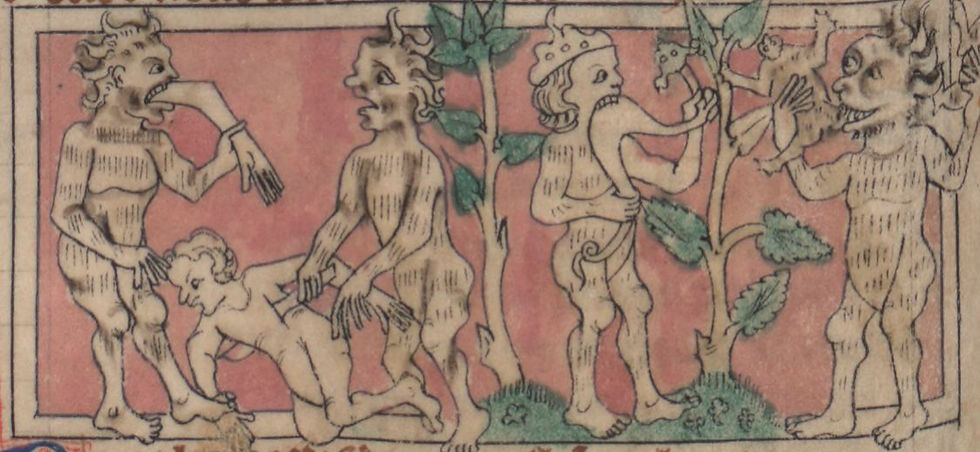
Popular culture and traditional folklore often depict Yajuj and Majuj (Gog and Magog) as monstrous, hidden tribes or supernatural entities waiting behind a physical wall to destroy the world in an apocalyptic future. This narrative, while vivid, obscures the functional guidance provided within the Quranic text. When we strip away these mythological layers, a different picture emerges: one of social dynamics, environmental corruption, and the structural requirements of stable governance.
The Quranic account of Dhul-Qarnayn and these forces is not a historical legend, but a rigorous framework for addressing overwhelming social and systemic corruption (fasad). As a systems analyst would approach a failing infrastructure, we must look at the linguistic roots and functional characterisations to identify the "burning" instabilities that threaten social order. This investigation moves us from mythology to a methodology for identifying and containing the entropic forces that disrupt modern civilisations.
1. Takeaway 1: They Aren't Tribes—They Are "Agitated Dynamics"
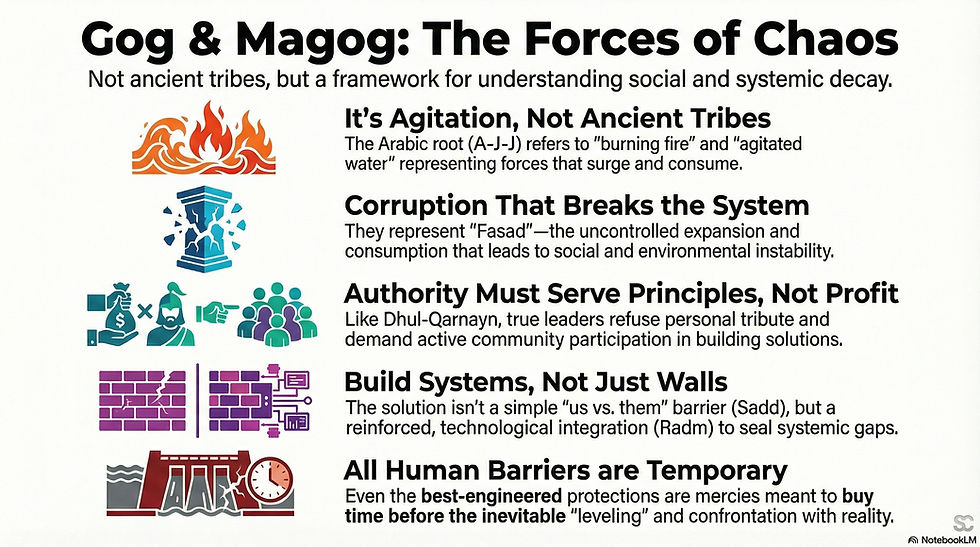
The terms Yajuj and Majuj are derived from the Arabic root A-J-J (أ-ج-ج). In the Quran, this root is consistently associated with agitation, burning, and intense saltiness. For example, in verses 35:12 and 56:70, the word ujāj is used to describe water that is so salt-heavy and bitter that it "burns" or causes thirst rather than quenching it. Similarly, the term ajeej refers to the roaring, consuming sound of a blazing fire.
Linguistically and functionally, these are not names of biological species but descriptions of a specific dynamic of fasad—the breaking of natural order, hoarding of resources, and the prevention of healthy flow.
Yajuj (Active Dynamic): An inflammatory force characterised by rapid, uncontrolled expansion and agitation. It is the "burning" agent that actively surges and consumes resources.
Majuj (Passive/Resultant Dynamic): The state of being consumed or the resultant spread of that agitation. It is the overwhelming wave that follows the initial inflammatory spark.
Yajuj: A dynamic of entropy and uncontrolled expansion that behaves like a roaring fire or bitter water—an agitated force that actively surges, consumes resources, and causes social or environmental "burning."
2. Takeaway 2: Dhul-Qarnayn is a "Bridge of Epochs," Not a "Two-Horned King"
To understand the solution to this agitation, we must redefine the protagonist, Dhul-Qarnayn. While traditionally translated as "The Two-Horned One," it is critical to note that the physical meaning of "horn" for the root Q-R-N (ق-ر-ن) does not appear anywhere in the Quran. Instead, the root consistently refers to time periods, generations, or epochs (as seen in 19:74, 19:98, and 6:6).
Dhul-Qarnayn is "The One of the Two Periods/Epochs." This title characterises him as a bridge—a figure who possesses the capacity (makan) and the means (sabab) to transition a society between states of time. His authority is defined by three journeys that serve as a map of comprehensive governance:
The Western Limit (18:86): Reaching the point of "judgment," where he must decide between punishment and goodness.
The Eastern Limit (18:90): Addressing the "vulnerable," those exposed and without cover or protection.
The Structural Gap (18:93): Finding the people between barriers who struggle with comprehension and communication.
Dhul-Qarnayn is a leadership model that manages the extremes of social justice, vulnerability, and structural instability.
3. Takeaway 3: The Secret to Stability is "Radm," Not Just a "Sadd"
When the people living in the wake of Yajuj and Majuj's corruption approached Dhul-Qarnayn, they requested a Sadd—a simple barrier or obstruction. However, the analyst-governor recognised that a simple wall was insufficient for the scale of the agitation. He proposed an upgraded solution: a Radm.
Sadd: A simple wall or dam that creates a binary "us vs. them" separation.
Radm: A multi-layered fortification or a "filling of the gap" that creates structural integration.
Dhul-Qarnayn provided a technical specification for this barrier, utilising sabab (means/causes) rather than supernatural feats. The process described in 18:96 involves a metallurgical synthesis:
Preparation: Aligning masses of iron (zubar al-hadid) between natural cliff faces (as-sadafayn).
Agitation: Using bellows to blow fire until the iron reaches a molten state.
Reinforcement: Pouring molten copper (qitr) over the iron to seal and bind the structure.
This resulting Radm was functionally complete: they were unable to scale it, nor could they pierce it (18:97). It represents the stabilisation of a system through the integration of strength and binding elements.
"He said: 'What my Lord has established me in is better, so assist me with strength/force; I will make between you and them a rampart/filled barrier (radm).'" (18:95)
4. Takeaway 4: Real Authority Rejects Tribute and Demands Participation
A vital principle of governance is revealed in the exchange regarding Kharaj (tribute). The people offered Dhul-Qarnayn a Kharaj—a term from the root K-R-J meaning "to exit." They were offering wealth to "exit" their possession in exchange for security. Dhul-Qarnayn rejected this, stating: "What my Lord has established me in is better."
By refusing the tribute, he established that principled authority does not operate as a mercenary service. More importantly, he refused to provide passive protection. He commanded the people: "Assist me with strength/force" (quwwah). This is the principle of participatory governance: true protection from systemic corruption requires the collective effort and the "strength" of the community itself, not a passive reliance on a distant leader.
5. Takeaway 5: The Inevitable Levelling—Why Even Good Barriers are Temporary
The Quranic perspective on systems engineering is grounded in the reality of entropy. Even the most perfect human-built structure—the Radm—is a "mercy" (rahmah), meaning it is a temporary protection that buys time for human development.
Dakka’ (Leveled): In 18:98, Dhul-Qarnayn acknowledges that when the "promise" of the Lord comes, the barrier will be flattened. No system remains closed forever.
Hadab and Yansilun (The Breach): In 21:96, the eventual release of these forces is described as flowing rapidly (yansilun) from every elevation (hadab).
The term yansilun—also used for the hastening of people from graves (36:51)—suggests a systemic breach where corruption streams forth from every direction. This is not an army marching down a hill; it is a description of a system's structural integrity finally failing, leading to an overwhelming surge of the previously contained agitation.
"He said: 'This is a mercy from my Lord. But when the promise of my Lord comes, He will make it level (dakka’). And the promise of my Lord is true.'" (18:98)
"Until when Yajuj and Majuj are opened, and they from every elevation (hadab) flow rapidly (yansilun)." (21:96)
Conclusion: From Mythology to Methodology
The account of Yajuj and Majuj is a functional blueprint for systemic stabilization. These are not monsters in a cave, but persistent, agitated forces of chaos and fasad that arise when human consumption and social order lose their balance.
The Quranic guidance is clinical: containing these forces requires principled leadership that rejects personal gain, a community that contributes its collective quwwah (strength), and the engineering of robust Radm structures to fill the gaps in our systems. While these barriers are temporary mercies, they are the essential tools of the "One of the Two Epochs" who seeks to maintain order against the "burning" dynamics of corruption.
Final Thought: In an age of surging social and environmental "burning," what are the structural gaps we are failing to fill with our collective strength?
References


Comments