Did Prophet Muhammad Split the Moon
- Qur'an Explorer

- Dec 29, 2025
- 9 min read
Updated: Mar 30

The Case Against Physical Miracles: A Scriptural and Scientific Audit
For centuries, traditional narratives have attributed hundreds of "miracles" (mu’jizāt) to the Prophet Muhammad—from the splitting of the moon to water gushing from his fingertips. However, when the Qur’an is analyzed as a self-contained system of guidance, it reveals a startling reality: The text consistently denies the Messenger the use of physical miracles.
1. The Scriptural Negation: "Only a Warner"
The Qur’an establishes a clear boundary regarding the Messenger’s capabilities. In every instance where his audience demanded a physical sign (āyah), the response was a functional restriction.
The Injunction of Limitation: In Surah 13:7 and 29:50, the text records the demand for a miracle and responds: "You are only a warner." The use of the Arabic particle innamā (only/nothing but) creates an exclusive identity. If the Prophet had performed miracles, these verses would be factually incorrect within the context of the revelation.
The "Sufficient" Argument: Surah 29:51 asks, "Is it not sufficient for them that We sent down to you the Book?" The text positions the discourse as the replacement for the physical sign. To claim the Prophet performed physical miracles is to argue that the Book was not sufficient.
The "Humanity" Defense (17:90–93): The audience provides a list of specific demands: gushing springs from the earth, gardens appearing instantly, or a ladder to heaven to bring down a physical book. The response is a rhetorical question that establishes a hard boundary:"Say: 'Glory be to my Lord! Am I anything but a human messenger?' (hal kuntu illā basharan rasūlā)." By contrasting "Glory to God" with "I am only human," the text asserts that manipulating physical laws is a divine prerogative that a Bashar (human) has no part in.
The "Unseen" Restriction (10:20): When challenged as to why a sign has not been "sent down," the text commands the Prophet to defer to the "Unseen":"And they say: 'Why is a sign not sent down to him from his Lord?' Say: 'The Unseen (Al-Ghayb) belongs only to God, so wait; I am with you among those who wait.'" Within the Qur’an’s closed system, miracles are categorized under Al-Ghayb. By stating that the Unseen belongs only to God, the text explicitly denies the Prophet access to the "control panel" of physical reality.
The Futility of Signs (6:109): Some swore their strongest oaths that they would believe if a sign came. The Qur’an’s internal logic dismisses this as a misunderstanding of how belief works:"Say: 'The signs are only with God.' And what will make you perceive that even if a sign came, they would not believe?" The text argues that physical wonders do not produce Imān (conviction); they only produce temporary amazement.
The "Treasurer" Negation (6:50): To ensure the Messenger is not viewed as a demigod or a magician, the text commands him to declare:"Say: 'I do not tell you that I have the treasures of God, nor do I know the Unseen, nor do I tell you that I am an angel. I only follow what is revealed to me.'" This "triple negation" (no treasures, no secret knowledge, no angelic nature) leaves no room for the performance of the "miracles" found in later tradition.
The Qur’an does not merely "omit" the Prophet's miracles; it anticipates the demand for them and categorically refuses to fulfill it. The text frames the Prophet as a messenger whose authority is derived from the message (the revelation) rather than a mastery over matter (the physical world).
2. Case Study: The "Splitting of the Moon" (54:1)
This event is often cited as one of the Prophet's greatest miracles, yet the internal and external evidence suggests otherwise.
1. The Scriptural Context
The verse states: "The Hour has drawn near, and the moon has split." 1. Apocalyptic Timing: The "Hour" (Al-Sā’ah) in the Qur’an always refers to the end of the world. The splitting of the moon is framed as a future cosmic sign of the Day of Judgment, not a past event for a specific audience.
Lack of Agency: Unlike the signs of Moses (where he is told to "strike the sea"), there is no mention of the Prophet Muhammad's involvement, his pointing at the moon, or his agency in this verse.
1.1. Grammatical and Contextual Analysis of 54:1
The verse reads: “Iqtarabati al-sā’atu wa-inshaqqa al-qamar” (“The Hour has drawn near, and the moon has split/is cleft.”)
The "Hour" (Al-Sā’ah)
In the Qur’anic system, Al-Sā’ah is a technical term used exclusively for the End of the World/Resurrection.
Internal Rule: Every time the "Hour" is mentioned as "drawing near," it refers to a cosmic, apocalyptic event (e.g., 33:63, 42:17).
The Past Tense (Māḍī): In Arabic, the past tense is frequently used in the Qur'an to describe future apocalyptic events to emphasize their certainty. For example, 16:1 says "Atā amru Allāhi" ("The command of God has come"), even though the Day of Judgment has not yet arrived.
The Splitting (Inshiqāq)
The root sh-q-q (to split/cleave) is used elsewhere in the Qur'an to describe the destruction of the heavens at the end of time:
82:1: "Idhā al-samā’u unfaṭarat" (When the sky is cleft asunder).
84:1: "Idhā al-samā’u inshaqqat" (When the sky is split/cleft).
Internal Conclusion: Within the text's own logic, the "splitting of the moon" is a future cosmic sign of the Hour, not a past event performed by a man. The text links the splitting of the moon directly to the Sā’ah (The Hour), placing it in the category of apocalyptic phenomena.
1.2. Absence of Agency
If this were a miracle performed by the Messenger, the internal grammar would likely reflect his agency (e.g., "We split the moon for you" or "You split the moon by Our leave").
In the cases of Moses (splitting the sea in 26:63) or Jesus (healing in 5:110), the text explicitly mentions their action or the request for the sign.
In 54:1, the moon simply "splits." There is no mention of Muhammad, no mention of him pointing at it, and no mention of the Quraish asking for this specific sign.
1.3. The "Magic" Charge (54:2)
The following verse says: "And if they see an āyah (sign), they turn away and say: 'Sihrun mustamir' (Ongoing magic)." Proponents of the miracle claim this proves the Makkans saw the moon split. However, the Qur’anic system shows that:
The disbelievers called the Qur’an itself "magic" (38:4, 43:30, 74:24).
Whenever they were warned about the Hour or shown the "signs" in nature, they dismissed the message as enchantment.
The text says "If they see an āyah" (generic), not "the āyah" (the specific moon splitting).
1.4. The Response to Specific Demands
In 17:90-93, the text lists the specific miracles the people demanded:
Causing a spring to gush from the earth.
Having a garden of palms and grapes with rivers.
Causing the sky to fall in fragments.
Bringing God and the angels face-to-face.
Ascending into heaven and bringing down a physical book.
The Qur’anic response to this list is a total negation of the Messenger’s agency:
"Say: 'Glory be to my Lord! Am I anything but a human messenger?' (hal kuntu illā basharan rasūlā)."
Summary of the Exegetical Finding
54:1 describes a prophecy of the end times, not a past miracle.
Chapter 17:59 explicitly states that God stopped sending physical "signs" because previous nations denied them.
Scientific and historical records confirm that no such physical event occurred in the 7th century.
The "miracle" is a later construct of tradition (Hadith and Tafsir) that was projected back onto a verse that actually describes the apocalyptic end of the universe.
2. Scientific and Historical Evidence
Since you asked for external evidence, we can look at the physical and historical records from the 7th century:
2.1. Astronomical and Historical Silence
Global Visibility: A literal splitting of the moon would be a global event. In the 7th century, astronomers in China, India, and Byzantium were meticulously recording celestial events (eclipses, comets, etc.). There is no record in any of these civilizations of the moon splitting in half.
Tidal Catastrophe: From a physics standpoint, the moon's gravity dictates Earth's tides and axial stability. If the moon were to physically move apart into two halves, the gravitational shift would cause global tsunamis and catastrophic geological upheaval. No such event is recorded in the geological or historical record of the 620s CE.
2.2. NASA and the "Rilles"
A common modern claim uses NASA photos of Rima Ariadaeus (a lunar trench) as "proof" of the split.
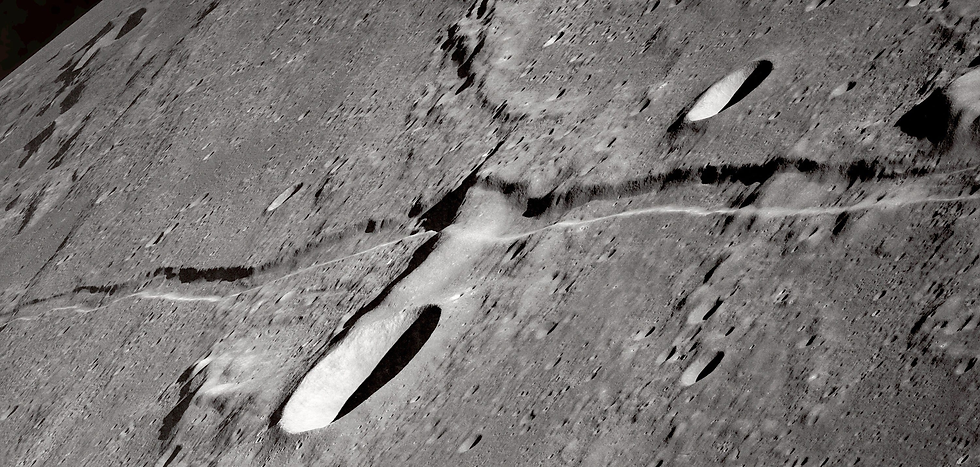
The Reality: NASA scientists (such as Brad Bailey) have officially stated that there is no evidence the moon was ever split into two pieces. These rilles are standard geological features (grabens) formed by volcanic activity or crustal cooling billions of years ago. They do not wrap around the moon, nor do they indicate a structural break of the entire sphere.
3. The Hadith "Miracles" vs. the Qur’anic Sunnah
Post-Qur’anic traditions (Hadith) describe the Prophet multiplying food, healing the blind, and producing water from his hands. These accounts face a massive internal hurdle within the Qur’an:
The Law of Previous Nations (17:59): The Qur’an explicitly states: "And nothing prevented Us from sending the signs except that the former people denied them." * Internal Contradiction: If the Prophet had performed even one of the miracles mentioned in the Hadith, this verse (17:59) would be invalidated. The Qur’an claims God stopped sending physical signs to avoid the immediate destruction that follows their rejection.
4. Why the Denial?
The Qur’an argues that physical miracles are low-level evidence. They appeal to the senses but do not necessarily change the heart; indeed, the text notes that those who saw Moses's signs often called them "magic."
The "Sign" of the final Messenger was shifted from the Material to the Intellectual. By denying the Prophet the ability to break physical laws, the Qur'an forces the seeker to engage with the content of the message rather than the power of the messenger.
The word mu’jizah (miracle) does not appear in the Qur’an. Instead, the text consistently uses the term āyah (plural: āyāt) to describe phenomena that intervene in the natural or social order. By tracking the usage of āyah and the root ‘ajaza, we can define these concepts using only the internal logic of the Book.
4.1. Defining the Āyah (Sign) vs. The Concept of "Miracle"
While tradition calls extraordinary events "miracles," the Qur’an calls them āyāt. Within the system of the text, an āyāt is not a "magic trick" to entertain; it is a pointer or a clear proof.
As Natural Law: The Qur’an identifies the sun, moon, and the alternation of night and day as āyāt (10:5, 41:37). Therefore, an āyah is fundamentally something that reveals a designer, whether it is "supernatural" or "natural."
As "Extraordinary" Verification: When messengers are asked for proof, they provide an āyah. For example, the "She-Camel" is called nāqatullāhi lakum āyatan ("The camel of God for you as a sign") in 7:73.
4.2. The Root ‘Ajaza (To be Ineffective/Unable)
Since the word "miracle" (mu’jizah) comes from the root ‘-j-z, we must look at how the Qur'an defines this root. In the text, ‘ajaza refers to incapacity or the inability to escape.
Human Incapacity: In 5:31, a character says, "A-’ajaztu..." ("Am I unable/too weak to be like this crow..."). Here, the root defines a lack of power or skill.
God’s Power vs. Escape: The text frequently states that the rejectors cannot mu’jizīn ("be ones who frustrate/escape") God on earth or in heaven (29:22, 6:134).
Internal Definition: Within the Qur’anic system, something "miraculous" isn't just a wonder; it is an act that renders the opponent incapable (‘ajaza) of replicating it or escaping its implications.
4.3. The Function of the "Sign" (Āyah)
By cross-referencing verses where people demand "signs," we see a consistent internal pattern regarding their purpose:
Verse | Context | Result/Purpose |
17:59 | Prevention of signs | Āyāt are sent only to strike "fear" or "awe" (takhwīfan). |
7:106-108 | Moses and Pharaoh | The āyah (the staff/hand) is a "clear authority" (sulṭānim-mubīn). |
6:37 | Demand for a sign | The text states God is qādir (capable) of sending one, but most do not "know." |
4.4. The Self-Referential "Miracle": The Text Itself
The Qur’an positions itself as the ultimate āyah that renders the listener "incapable" (‘ajaza). It issues a "challenge" (Tahaddi) that defines its own miraculous nature:
In 17:88, the text claims that if humans and Jinn gathered to produce the "like of this Qur’an," they could not do so.
In 2:23, it challenges those in doubt to produce a sūrah (chapter) like it.
The Qur’an replaces the concept of "miracle" (a violation of nature) with the concept of the Sign (āyah). These signs are intended to move the observer from a state of incapacity (‘ajz) to a state of recognition. The text argues that while physical wonders were given to previous messengers, the current, persistent āyah is the Qur’anic discourse itself, which it claims cannot be replicated by human effort.
Conclusion
The "Miracles of Muhammad" are a product of later hagiography designed to make him compete with the "Signs" of Moses and Jesus. According to the Qur'an itself, he was a human being (bashar) whose only "miracle" was the receipt of a discourse that challenged the human intellect. To insist on physical miracles is to ignore the Qur’an’s own definition of its Messenger.


Comments